The aerospace and defense industry is at a pivotal moment. A confluence of soaring commercial demand, urgent defense modernization, and the dawn of new technological frontiers has created a landscape of unprecedented opportunity and immense pressure. With commercial aircraft backlogs stretching an astonishing 8-10 years at current production rates and new defense imperatives like hypersonics demanding entirely new manufacturing paradigms, the central question is no longer what to build, but how to build it at the required scale and speed.
The answer, and the primary obstacle, lies in a quiet revolution: advanced materials science. The very materials that enable next-generation performance have created a profound manufacturing paradox. The push for lighter, stronger, and more heat-resistant airplane components has led us to a point where the industrial base's ability to shape advanced materials is now the critical gating factor for progress.
A Systems-Level Challenge, From Alloy to Airframe
The shift away from an 80% aluminum airframe is well-documented. Today, a modern jetliner is a complex mosaic of materials, with advanced composites comprising up to 50% of its weight and engine components forged from sophisticated heat-resistant superalloys (HRSAs) like Inconel and titanium alloys. These materials are engineering triumphs, capable of withstanding temperatures and stresses that were unimaginable a generation ago.
However, the attributes that give them their strength in the air pose a challenge on the ground. They are notoriously difficult to machine.
This isn't just a tooling problem; it's a systems-level challenge. The introduction of a new alloy reverberates across the entire manufacturing process. It changes the rules for the machine tool, the CAM software that generates the toolpaths, and the cutting tool at the point of contact. The physics of the cut itself becomes a storm of extreme heat and pressure, causing rapid tool wear and introducing stresses into components where perfect reliability is the only acceptable standard.
Machining HRSAs can be four to five times slower than conventional steel, creating a significant bottleneck that threatens production velocity. For an industry tasked with both clearing historic backlogs and pioneering technologies that travel at Mach 5, this bottleneck is not just an operational headache but a strategic vulnerability.
The New Collaborative Mandate: Co-Engineering the Solution
Overcoming this challenge requires a fundamental evolution in the relationship between designers, manufacturers, and their technology partners. The old transactional model of simply supplying a tool for a pre-defined process is no longer viable. The immense complexity demands a new mandate for collaboration where the manufacturing solution is co-engineered alongside the component itself.
Success now hinges on a partnership that begins long before the first chip is cut. It involves a deep dive into the application, where materials scientists, design and application engineers work on the factory floor to create a holistic machining strategy. This means engineering the tool's geometry, its tungsten carbide substrate, and its coating in concert to master the unique challenges of a specific application. This approach moves beyond simply selling a product and instead delivers a predictable, optimized process. It transforms a supplier into a strategic partner who is invested in the outcome, helping to de-risk production and accelerate output.
From Theory to the Factory Floor
Consider the immense challenge of sculpting a single, monolithic titanium structural component for a modern fighter jet from a solid block of metal. The goal is to remove massive amounts of material as quickly as possible—a process known as aggressive roughing—without compromising the integrity of the final part or causing premature tool failure.
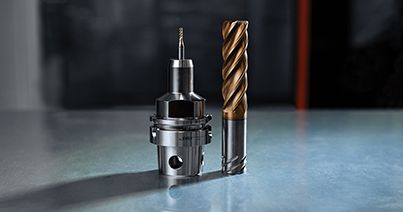
Solving this requires a class of tooling engineered specifically for this environment. The solution must combine an exceptionally tough carbide grade with a geometry designed for maximum stability and unparalleled chip evacuation. Efficiently removing chips from the cutting zone is critical; it prevents heat buildup and reduces cutting forces, allowing the machine to run faster, more aggressively and with high productivity. This class of application-specific tooling, exemplified by solutions like our high performance HARVI™ II TE solid carbide end mills, is what turns theory into practice.
By deploying these highly engineered solutions, manufacturers are fundamentally changing their production equations. We have seen our partners slash cycle times on critical titanium components by as much as 75 percent and more than 60 percent life improvement on difficult HRSA engine parts, dramatically reducing defect rates. This level of partnership and process optimization is why the value of specialized tooling content on key airframes has grown significantly, reflecting a deeper integration to solve the most pressing manufacturing challenges.
The future of aerospace—from clearing today's backlogs to enabling tomorrow's hypersonic ambitions—will be determined on the factory floor. The winners of this new race will be those who recognize that mastering the physics of the cut is not just a manufacturing detail, but a strategic imperative.
This article recently appeared on AviationWeek.com.